
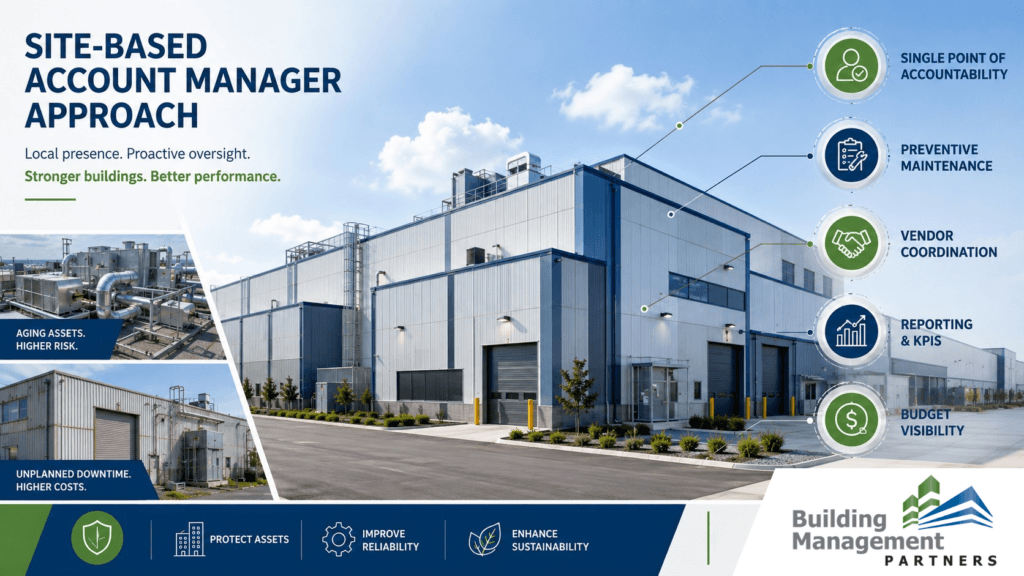
Why a Site-Based Account Manager Can Transform Facility Operations
For many organizations, facility management has developed piece by piece.
One person handles maintenance requests. Another manages vendors. Someone in finance reviews invoices. Department leaders chase updates. Preventive maintenance lives in a spreadsheet, a binder or, in less flattering cases, someone’s memory.
That arrangement can work when a property is small and simple. As the number of buildings, systems, vendors and occupants grows, the cracks begin to show.
A site-based account manager brings structure to that complexity by giving the organization one dedicated professional who understands the property, coordinates the work and is accountable for results.
It is not simply another layer of management. Done properly, it is the operating system for the facility.
One Point of Accountability
The most immediate benefit is clarity.
Instead of staff members calling different contractors, tracking down technicians or wondering who owns the next step, they have one person responsible for the facility program.
A site-based account manager can coordinate:
- Maintenance and janitorial staff
- HVAC, plumbing and electrical vendors
- Landscaping and snow removal
- Fire protection, elevators and life-safety systems
- Work orders and preventive maintenance
- Capital planning and budget reporting
This eliminates the familiar problem of having several vendors involved and no one clearly responsible for the final outcome.
When something goes wrong, the question is no longer, “Who is handling this?” There is already an answer.
Faster Response and Better Prioritization
Not every maintenance request carries the same urgency.
A leaking faucet, a failed rooftop unit and a life-safety issue should not enter the same queue and wait their turn. Yet without professional oversight, work often gets handled based on who complains the loudest or which contractor happens to answer the phone first.
A site-based account manager can evaluate requests, assign priority and coordinate the right response. Because that person is already familiar with the property, its equipment and its occupants, less time is wasted explaining the situation or determining who should be involved.
That translates into:
⚡ Faster response times
🔧 Better coordination
📋 Clearer follow-through
🏢 Less disruption to building users
The value is not merely speed. It is informed speed.
A Shift from Reactive to Preventive
Reactive maintenance is expensive, disruptive, and oddly persistent.
Organizations know preventive maintenance matters, but it is often postponed when daily requests pile up. Filters are not changed. Inspections are missed. Minor issues are deferred until they become major failures.
A site-based account manager helps establish and enforce a preventive maintenance program. Equipment can be inventoried, service schedules documented, and recurring tasks tracked through a formal work order system.
That creates a more disciplined approach to:
- HVAC maintenance
- Electrical and lighting systems
- Plumbing and backflow prevention
- Life-safety inspections
- Building envelope conditions
- Warranty requirements
- Equipment replacement planning
Structured preventive maintenance reduces emergency repairs, improves equipment reliability, and can extend useful asset life. It also replaces the costly habit of waiting for failure with a planned approach to maintenance and replacement.
Better Vendor Management
Most properties rely on multiple service providers. That is normal. Managing them independently is where the trouble starts.
Separate contracts, scopes, invoices, service records, and contacts create administrative drag. Performance standards may vary, and pricing may go unchallenged for years because no one has the time or technical context to review it.
A site-based account manager can serve as the central coordinator for every vendor relationship. That includes onboarding, scheduling, scope review, quality control, invoice verification, and performance evaluation.
The result is not necessarily fewer vendors. The result is better-managed vendors.
That distinction matters.
Vendor consolidation, competitive bidding and consistent oversight can improve service while creating opportunities for cost control. Savings come from structure, not from simply choosing the cheapest contractor and hoping for the best.
More Useful Data and Reporting
Facility management is often expected to operate on anecdotal information.
Leadership hears that “the HVAC is old,” “repairs are increasing,” or “that building needs work.” Those statements may be true, but they are not enough to support budgeting or capital decisions.
A site-based account manager supported by a computerized maintenance management system can provide clearer visibility into:
📊 Work order volume and completion
⏱️ Response times
🔄 Preventive maintenance compliance
💵 Spending by building or system
🧰 Repair history by asset
📅 Upcoming replacement needs
📉 Deferred maintenance trends
This data helps leadership move from scattered invoices and opinions to a more accurate view of facility performance.
It also creates an audit trail. Requests are logged, assigned, completed, and documented rather than disappearing into email threads or paper tickets.
Stronger Budget and Capital Planning
The real financial value of a site-based approach often appears over time.
Without asset data and condition tracking, capital spending is largely reactive. A major unit fails, a roof leaks or an electrical problem reaches a critical point, and leadership is forced to fund an unplanned project.
A site-based account manager can help build a forward-looking capital plan based on:
- Equipment condition
- Remaining useful life
- Repair frequency
- Operational importance
- Deferred maintenance
- Budget priorities
This allows organizations to develop one-year, five-year and longer-term capital roadmaps rather than starting each budget cycle with guesswork.
Budget predictability may not sound exciting, but neither is explaining an avoidable six-figure emergency repair to senior leadership.
Supporting Existing Staff, Not Replacing Them
A common misconception is that outsourced facility management requires replacing the existing team.
That is not always the case.
In many situations, the better approach is to retain trusted maintenance and janitorial employees while adding professional leadership, scheduling and accountability. The site-based manager provides daily assignments, prioritization, quality control and support, allowing the existing team to perform more effectively.
This model is especially useful when an organization has capable employees but lacks a dedicated facility leader.
The goal is not disruption. It is structure.
Where the Model Works Best
A site-based account manager is especially valuable in environments where facility complexity has outgrown the current management model.
Multi-Building Campuses
Schools, municipalities, healthcare campuses, corporate offices and institutional properties often have several buildings competing for limited maintenance resources. A site-based manager helps standardize service and prevent lower-profile buildings from being ignored.
Properties with Multiple Vendors
When HVAC, elevators, landscaping, fire protection, plumbing and specialty systems are all handled separately, one coordinator can reduce the administrative burden and improve accountability.
Organizations with Limited Internal Facility Leadership
Some organizations have maintenance staff but no experienced facility manager. Others rely on operations, finance or executive leadership to coordinate building issues in addition to their actual jobs.
That arrangement usually functions right up until it does not.
Aging Facilities
Older buildings require more planning, stronger preventive maintenance and better capital forecasting. A dedicated site-based leader can help distinguish between a repair, a recurring problem and a system approaching the end of its useful life.
High-Occupancy or Mission-Critical Environments
Healthcare, senior living, government, manufacturing and institutional properties cannot afford frequent disruptions. A consistent on-site presence improves response, communication and operational readiness.
The Bottom Line
A site-based account manager creates value by turning fragmented facility activity into a coordinated program.
Organizations gain:
✅ One accountable leader
✅ Faster and better-prioritized response
✅ Stronger preventive maintenance
✅ More disciplined vendor management
✅ Clearer reporting and budget visibility
✅ Better long-term capital planning
✅ Greater support for existing staff
The model is not necessary for every property. A small building with limited systems may be well served by mobile or on-demand maintenance.
But once facility operations become complex, relying on informal coordination is not lean. It is simply unmanaged risk wearing a name tag.
A site-based account manager provides the leadership, visibility, and structure needed to protect the property, support its occupants, and help the organization make better decisions over the long term.